Sun Salutation A
The full sequence with breath, Sanskrit, pronunciation, and gaze for every pose, plus how to cue it and how to make it work for every body in the room.
Sun Salutations, or Surya Namaskar, are a short series of postures most commonly seen in Vinyasa classes. They build heat, warming the body from the inside in preparation for the postures that follow. Sun Salutation A is the one nearly every Vinyasa class opens with, and the one most new teachers cue first.
What teachers mean by "move through your vinyasa." In a typical Vinyasa class, one chunk of the full sun salute gets isolated and used as a transition between postures: Chaturanga, Upward Facing Dog, Downward Facing Dog. That short piece is what an instructor is referring to. The full Sun Salutation A has several more steps, laid out below.
Quick Sanskrit lesson. Vi- means in a special way. Nyasa- means to place. Vinyasa can be interpreted as connecting breath and movement.
The Sequence
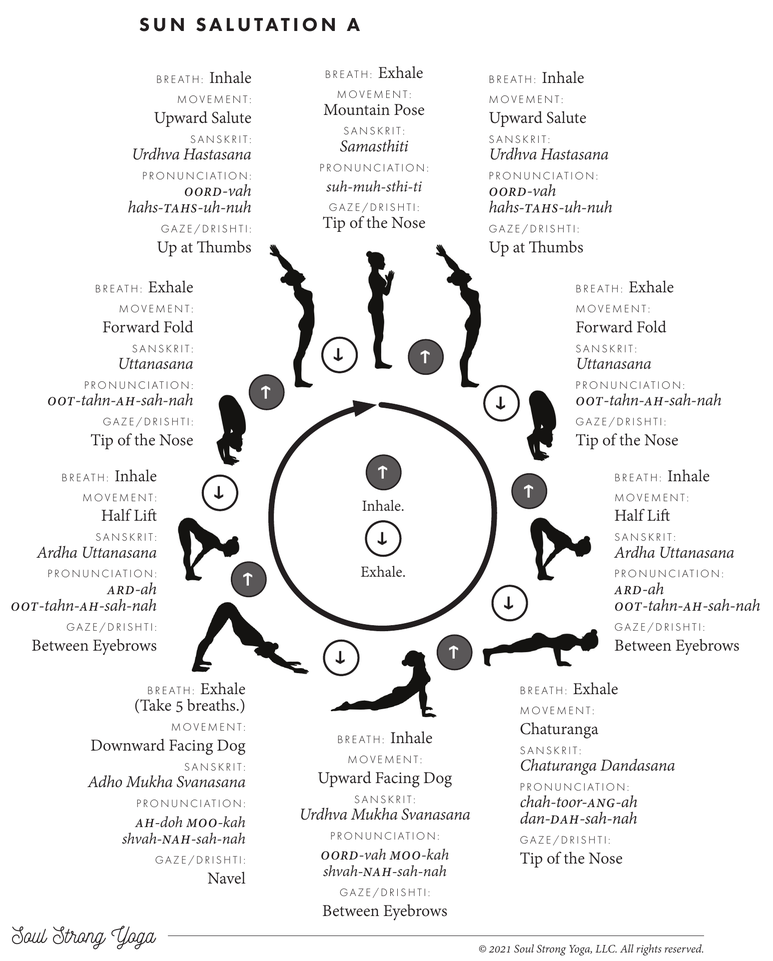
Eleven steps, one breath per movement, with five breaths held in Downward Facing Dog.
| Step | Breath | Pose | Sanskrit | Pronunciation | Drishti |
|---|---|---|---|---|---|
| 1 | Exhale | Mountain Pose | Samasthiti | suh-muh-sthi-ti | Tip of the nose |
| 2 | Inhale | Upward Salute | Urdhva Hastasana | OORD-vah hahs-TAHS-uh-nuh | Up at thumbs |
| 3 | Exhale | Forward Fold | Uttanasana | OOT-tahn-AH-sah-nah | Tip of the nose |
| 4 | Inhale | Half Lift | Ardha Uttanasana | ARD-ah OOT-tahn-AH-sah-nah | Between eyebrows |
| 5 | Exhale | Chaturanga | Chaturanga Dandasana | chah-toor-ANG-ah dan-DAH-sah-nah | Tip of the nose |
| 6 | Inhale | Upward Facing Dog | Urdhva Mukha Svanasana | OORD-vah MOO-kah shvah-NAH-sah-nah | Between eyebrows |
| 7 | Exhale then 5 breaths | Downward Facing Dog | Adho Mukha Svanasana | AH-doh MOO-kah shvah-NAH-sah-nah | Navel |
| 8 | Inhale | Half Lift | Ardha Uttanasana | ARD-ah OOT-tahn-AH-sah-nah | Between eyebrows |
| 9 | Exhale | Forward Fold | Uttanasana | OOT-tahn-AH-sah-nah | Tip of the nose |
| 10 | Inhale | Upward Salute | Urdhva Hastasana | OORD-vah hahs-TAHS-uh-nuh | Up at thumbs |
| 11 | Exhale | Mountain Pose | Samasthiti | suh-muh-sthi-ti | Tip of the nose |
On a phone, scroll the table sideways to see pronunciation and gaze.
How to Cue It
When you cue any pose, state four things in this order:
- Breath. Are students moving on an inhale or an exhale?
- Pose name. Tell students where they are going.
- Movement. Explain how to get there. Think about which part of the body moves first.
- Gaze. Once they arrive, help them find their drishti so they can live in the pose with focus.
If you find yourself at a loss for words early on, that is ordinary. The teachers who seem to always know the right thing to say got there through practice. Finding your voice takes time, and it keeps changing as your own practice evolves.
Modifying Sun Salutation A
Being able to cue a modified sun salutation is the difference between a class that welcomes everyone and a class that only works for some people. Offer these as ordinary options rather than corrections, and name them early so nobody has to ask.
Making space
- Step forward and back rather than jumping. Say it as one of two equal choices, not as the easier one.
- From Downward Facing Dog, walk the feet halfway forward, then walk the hands back to stand.
- Widen the feet in Forward Fold, Down Dog, and Chaturanga. Cue "take up space on your mat."
- Come down to one knee and step wide to the outside of the hand.
Lowering the impact
- Knees down in Chaturanga, with a folded blanket or mat under the knees.
- Blocks under the hands to reduce weight through the wrists, especially in Down Dog.
- Cobra in place of Upward Facing Dog, keeping the tops of the feet down and the effort lower.
- A folded blanket or foam wedge under the palms for sensitive wrists.
Bringing the floor closer
- Blocks under the hands in Forward Fold and Half Lift.
- Hands to the shins or thighs in Half Lift instead of to the floor.
- A chair or the wall for support in the standing portions.
Seated and chair versions
- Upward Salute, Forward Fold, and Half Lift all translate directly to a seated chair practice.
- Use the chair back or the wall for a standing version that keeps the sequence intact without weight on the hands.
- Keep all four chair feet securely on the floor, and put blocks or books under the feet so the knees are supported.
Language matters as much as the prop. Present options as different rather than easier or harder. "You might stay here, or explore this option. There is no hierarchy in these choices." Avoid "if you can't do this, do that," which quietly ranks the room.
Questions We Get
What is the difference between Sun Salutation A and B?
Sun Salutation B adds Chair Pose (Utkatasana) near the beginning and Warrior 1 (Virabhadrasana I) on each side, which makes it longer and warmer. A is the shorter foundational sequence and the one most classes open with.
How many sun salutations should I teach at the start of class?
Three to five rounds of A is a common opening for an all-levels class, enough to build heat without exhausting anyone before the standing sequence. Watch the room rather than the count.
Do I have to say the Sanskrit names?
You do not have to, and if you do, say them alongside the English rather than instead of it so nobody is lost mid-flow. Learning the pronunciation is worth it either way, because the Sanskrit names carry information about the poses themselves.
What does drishti mean?
Drishti is the gaze point. Giving students somewhere specific to look steadies balance and focus, and it keeps attention inside their own practice rather than on the person next to them.
Is it wrong to step instead of jump?
No. Stepping is a complete version of the pose transition, not a lesser one. Plenty of experienced practitioners step by choice.
Learn to cue with confidence. Sequencing, cueing, Sanskrit, anatomy, and accessible teaching are the core of our 200-hour training, built so you can teach real people in real rooms.
Explore our online YTT